
How Often Should You Retrain?
Ask Your CFO, Not Your Data Scientists
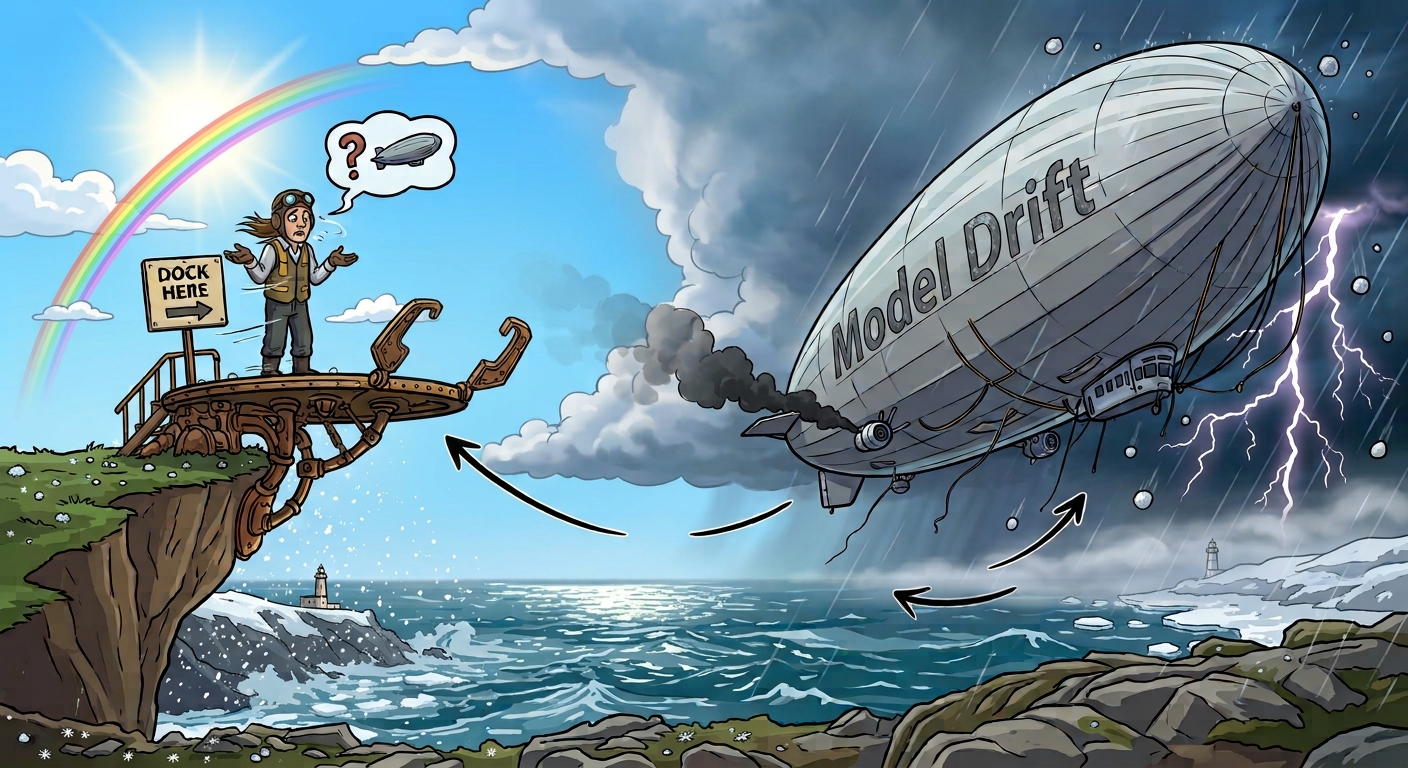
The markets are moving. Consumer sentiment is shifting. Your fraud patterns changed sometime in the last month, on a day nobody can name. Whether your models noticed depends on a decision most companies never made deliberately: how often to retrain.
Boards approved a lot of AI spending in 2024 and 2025. Now they want to know where the return went, and the reckoning is well underway: study after study this year reports that most enterprise AI initiatives never produce measurable P&L impact. The reasons vary, and integration failures get most of the press. But there is a quieter cause that hits even the projects that worked on launch day, and it has hard evidence behind it: a study in Nature Scientific Reports tested 32 models across industries and found that 91% degrade over time if left alone. A model is not a purchased asset. It is a decaying one.
The decay has a name: drift. The world a model was trained on stops matching the world it operates in. There is no outage and no alarm. Fraud slips through a little more often. Prices land a little wrong. A recommendation engine keeps suggesting what people wanted in March. By the time any of this reaches a quarterly number, nobody thinks to blame a model that hasn’t been retrained since spring.
Monitoring tells you the model drifted. It doesn’t tell you what fixing it is worth.
The industry did see this coming. There is now a mature category of observability tools that watch production models and flag statistically when inputs or behavior wander outside the training distribution: Arize, Fiddler, Arthur, Evidently, SageMaker Model Monitor. If you run models in production without one of these, start there.
But a drift alert is a diagnosis, and the cure is priced separately. When the alarm fires, “retrain” still means, for most teams, what it has meant for years. Assemble a representative dataset, say a rolling three-month window. Shuffle all of it, because gradient descent needs decorrelated batches. Run epochs until new weights converge, re-validate, redeploy. You pay for compute, engineering time, and deployment risk every single cycle, even when 99% of the data is identical to the last cycle. And note where the money actually goes: for many models the engineering is the expensive part, and most of that engineering is the retrain pipeline itself — the data assembly, the shuffling, the orchestration, the babysitting.
Practitioners will raise two objections here, and both deserve straight answers.
The first: why not skip the full retrain and fine-tune on the recent data? Because warm-starting half works, which is exactly why teams half-do it. A fine-tuned model tilts toward whatever it saw most recently and gradually forgets the rest. The deeper problem is removal. Fine-tuning can emphasize new data, but there is no clean way to take stale or bad data out of a network; its influence stays in the weights. So error accumulates in a different form, validation numbers sag, and eventually you do the full retrain you were trying to avoid.
The second: continuous learning already exists. True, ad-ranking systems have run streaming updates for over a decade. But online learning inherited the same two diseases in sharper form: instability under shifting data and no mechanism for removal, on top of operational complexity that kept it confined to a handful of companies with armies of ML engineers. There is a reason it never became standard enterprise practice. The industry’s actual revealed preference is periodic full retrains, spaced as far apart as teams can tolerate.
The retraining equation
That word, tolerate, is the crux. Retraining frequency is an economic tradeoff, not a technical constant. Two costs pull against each other.
Staleness costs you something every day the model runs behind the world: roughly, the daily accuracy decay times the revenue riding on each point of accuracy. For fraud or dynamic pricing this is real money. For a stable back-office classifier it rounds to zero.
Retraining costs you compute, engineering hours, validation, and the risk that comes with any redeployment.
The right cadence sits where those two curves cross, and it sits somewhere different for every model in your portfolio. Anyone selling a single cadence for all your models is selling astrology.
Put numbers on it. Take a model protecting $50M of annual revenue, losing a tenth of a point of effective accuracy per day, where a basis point of accuracy is worth about $200 a day. Staleness runs about $2,000 a day and compounds. If a full retrain costs $60,000 all-in, the arithmetic says retrain roughly monthly and accept the drift in between. A team on that schedule is not lazy. They are optimizing correctly against expensive retraining.
Now suppose the retrain costs $600 instead. Same model, same drift, same revenue. The arithmetic says update daily, and the staleness cost nearly disappears. Nothing about the model changed. When retraining gets cheap, the correct answer to “how often?” is not the old answer at a discount. It is a different answer.
Whether the multiplier for your workload is 100x, 20x, or 5x is an empirical question (more on that below) but notice that the conclusion doesn’t hinge on the exact figure. Even a 10x drop in that example moves the correct cadence from monthly to every few days. The size of the multiplier sets how far the answer moves; the direction is set by arithmetic.
Which suggests something uncomfortable: most teams are under-retraining today, rationally, because the current cost structure makes under-retraining the right call. Change the cost and the right call moves.
Where Optimizing Mind comes in
This is the problem we work on. Optimizing Mind’s solution learns for regulatory feedback rather than feed-forward neurons, and the property that matters for retraining is that they learn serially without catastrophic forgetting, and support genuine incremental removal — the missing mechanism that breaks both fine-tuning and online learning.
Go back to the three-month rolling window. With OM, the daily update is the delta and only the delta: drop the day that aged out, add the day that arrived. No reshuffling of 90 days of data. No epochs, no batches. No retraining the 89 days that didn’t change, and no residue of the removed day lingering in the weights. The update costs what the update is, and it takes most of the pipeline engineering with it, since there is no longer a quarterly data-assembly-and-shuffle production to stage.
Run that through the equation above and two things fall out. First, your drift monitor changes character. Today it is an alarm you dread, because acting on it is a project; with cheap updates it becomes a trigger you can simply obey. Scheduled window maintenance and unscheduled drift corrections, which today are two flavors of expensive, collapse into the same routine operation. Second, granularity gets affordable. Teams run one general model per problem because one is all they can maintain. When updates are cheap you can afford several window lengths in parallel, or per-region and per-segment models where a single blunt one used to serve.
Now, that multiplier. Our published Flash Transfer Learning results, adapting foundation models to new tasks with about 1% of the data, 100x less rehearsal, no forgetting, come from transfer-learning benchmarks. Rolling-window updates on production models are a different workload, and we haven’t published a number for it, so we won’t quote one. That is precisely what the free API trial is for: run your own data, measure your own multiplier, and put it into the equation above. The API drops into TensorFlow, PyTorch, and OpenVINO pipelines next to whatever monitoring you already run.
What to do with this
Take your model inventory and ask two questions of each entry. What does a day of staleness cost here? What does an update cost here? Your high-drift, revenue-critical models, fraud, pricing, recommendations, are almost certainly overdue for more frequent updates. Your stable ones aren’t, and shouldn’t get them. The line between the two is drawn by your cost of retraining, and that cost used to be a constant. It is now a variable.
Your monitoring already knows when the world has moved. The open question is whether you can afford to move with it.
Run the retraining equation on your own models with a free trial of the Flash Transfer Learning API at OptimizingMind.com.