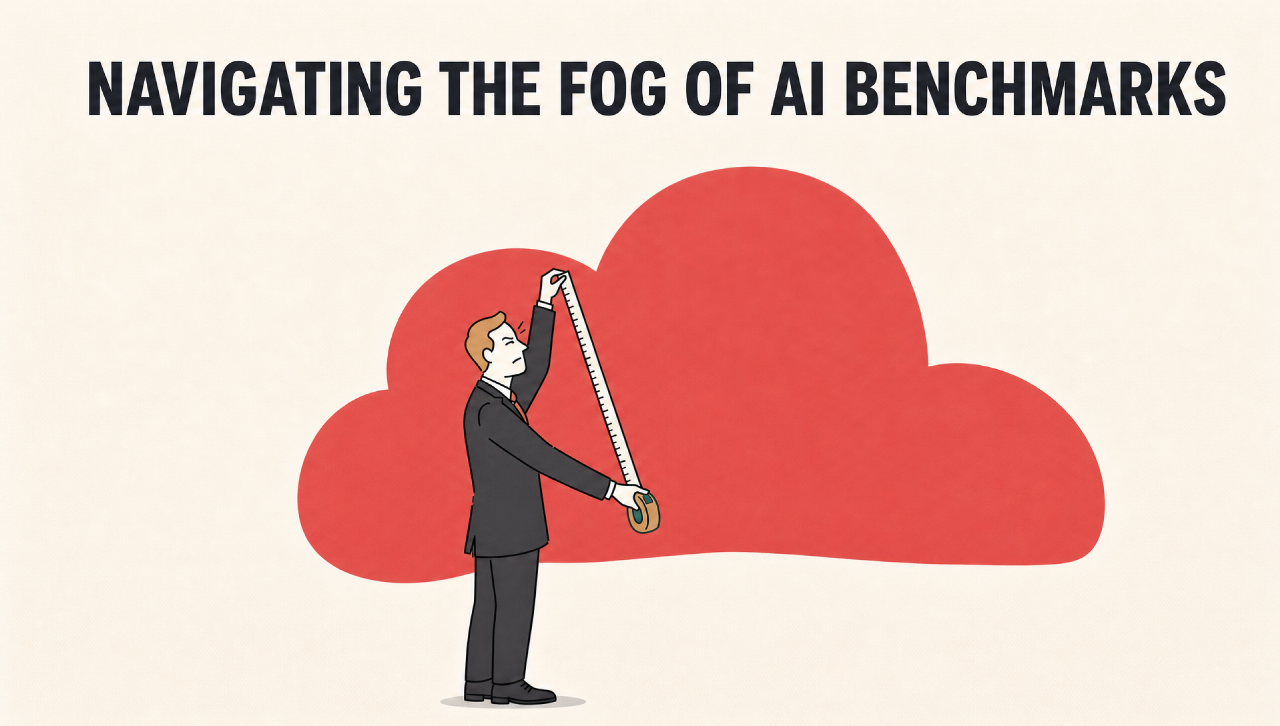
Navigating the Fog of AI Benchmarks
How to Sanity Check a “Faster AI Training” Claim
As artificial intelligence integration accelerates, many organizations are discovering a challenging reality: developing and maintaining AI models is often more resource-intensive and expensive than initial projections suggest.
For CEOs and CTOs, making informed decisions about AI infrastructure is critical to keeping projects on time and within budget. However, navigating the landscape of hardware and software benchmarks can be exceptionally difficult. Vendors frequently advertise claims of “faster training” or “unmatched efficiency,” but these metrics are often highly contextual.
To determine what these benchmarks actually mean for your specific project, it helps to understand the underlying mechanics of AI testing, the hidden variables in standard machine learning, and how to critically evaluate efficiency claims.
Inference vs. Learning: Clarifying the Metric
When evaluating AI speed, there are two primary metrics: performance (accuracy) and compute speed. However, the most critical distinction is understanding which phase of the AI lifecycle is being measured: Inference or Learning.
Inference is the process of the algorithm using what it has already learned to make a decision based on test data. Benchmarking inference is relatively straightforward:
- The AI is given a test data it has not seen before: examples held out of training.
- Percentage of correct decisions and the compute resources required to go from raw input to final output are measured.
While hardware is frequently benchmarked on inference speed or power consumption, inference costs scale with request volume and are forecastable, training costs recur unpredictably every time the model has to change.
Learning (or Training) is where inadequate benchmarking and unpredicted expenses occur. Benchmarking the training phase is vastly more complex, largely due to the fundamental architecture of the most widely adopted learning algorithms.
The Complexities of Benchmarking Gradient Descent
To accurately evaluate learning algorithms, hardware must be held constant while examining how many actual computations (data pieces, batches, and epochs) an algorithm requires to reach a target accuracy.
Currently, the vast majority of AI models rely on Gradient Descent. Conceptually, gradient descent is like placing an algorithm on a topographical map and having it step-by-step find the lowest point (the optimal solution). As it navigates, it adjusts its internal “weights.”
Because of this structure, benchmarking gradient descent introduces two major randomized variables:
- Initial Weights: The starting position on the map is randomized.
- Data Presentation: The order in which the training data is presented must be randomly shuffled.
Because the starting points and data order are randomized, every single training run will vary. Consequently, benchmark reporting should ideally be treated as a statistical experiment, showing averages and variances across multiple runs. Reports that only show a single, highly optimized run may not reflect the average real-world performance your engineering team will experience.
How the “No Free Lunch” Belief Shapes the Industry
In machine learning, the “No Free Lunch” theorem posits that no single algorithm is universally superior across all possible problems—optimizing for one type of data usually means sacrificing performance on another.
This belief reinforces current benchmarking philosophy and reporting, believing benchmarks are domain specific and differences are primarily due to inherent, unavoidable trade-offs. While benchmarks are designed to accommodate variations of gradient descent’s requirements, the industry only tests under those conditions with shuffled data and repetitive cycles. Benchmarks that are not optimal for gradient descent, such as non-shuffled (serial) benchmarking, evaluating performance before the epoch is complete, or testing completely non-gradient descent algorithms, are rarely looked at or reported. The prevailing philosophy assumes that if gradient descent fails under these conditions, evaluating them is pointless. This unintentionally blinds the industry to alternative architectures that could dramatically reduce compute time.
Catastrophic Forgetting and the Missed Metric of Data Efficiency
A critical consequence of designing benchmarks solely around gradient descent is the masking of how a model handles new information over time.
For gradient descent to work, data must be perfectly balanced and randomly shuffled. If an AI is trained on “Business Event A,” and a month later needs to learn “Business Event B,” you generally cannot simply feed it the new data sequentially. Doing so causes catastrophic forgetting, where the model overwrites its previous knowledge to accommodate the new inputs. To prevent this, the model must be retrained from the beginning using a shuffled mix of both the old and new data.
Some methods are designed to minimize learning problems such as fine-tuning, LoRA, replay buffers and EWC, by learning or updating only a subset of weights. However these methods remain beholden to gradient descent and are most reliable when retrained from the beginning using and shuffled old and new data.
Furthermore, because gradient descent relies on repeating entire cycles of data (epochs), benchmarks are designed to only measure performance at the end of an epoch. They rarely measure true data efficiency, meaning they do not evaluate how well an algorithm learns from a single piece of data presented just once.
Exploring Alternative Paradigms: Optimizing Mind
While the industry defaults to gradient descent and its associated benchmarking constraints, alternative mathematical approaches exist that bypass these limitations. Algorithms that do not rely on gradient descent offer a radically different set of operational characteristics:
- Elimination of Randomization: Weights and data sequences do not require randomization, making performance more predictable.
- Sequential Data Processing: They are fundamentally resistant to catastrophic forgetting. This allows data to be added to the network sequentially as the business evolves, completely eliminating the need for massive, from-scratch retraining cycles.
- Sub-Epoch Efficiency: Training can often be completed before a single epoch is even finished. Standard multi-epoch benchmarks fail to capture this peak efficiency because they only measure performance at the end of a full data cycle. They completely miss evaluating how the algorithm responds to very few data points—which is exactly the capability that accelerates engineering productivity the most.
For organizations looking to explore these alternative paradigms, Optimizing Mind offers a practical application of this architecture. They have developed the Flash Transfer Learning API, which utilizes brain-inspired continuous learning rather than standard gradient descent.
Because it evaluates data sequentially and learns rapidly within a fraction of an epoch, the Flash Transfer Learning API is designed to achieve high accuracy using remarkably few data points. By eliminating catastrophic forgetting, it allows engineering teams to continually update models as new business needs arise, without incurring the compounding cloud compute overhead dictated by traditional training methods.
Key Takeaways for Decision Makers
When evaluating a vendor claim regarding AI training speed or efficiency, consider asking your technical team the following sanity-check questions:
- Are we looking at statistical averages? If a benchmark does not show statistical variance, it is ignoring the randomized nature of standard training and likely represents a best-case, cherry-picked scenario.
- Does this benchmark account for how the model learns from just a few data points? Standard benchmarks that only evaluate performance at the end of long, multi-epoch data cycles overlook algorithms that achieve target accuracy almost immediately.
- How does this system handle sequential learning? Understand what the true compute cost will be when your company inevitably needs to add new data or categories to the model next quarter. Will it require a full retrain?
- Are we locked into Gradient Descent benchmarks? Standard benchmarks only compare gradient descent algorithms. The “No Free Lunch” philosophy may be preventing your team from looking at serial benchmarking.
By looking beyond surface-level claims and understanding the blind spots in how models are currently benchmarked, executive teams can make much more accurate forecasts regarding the true time-to-market and long-term maintenance costs of their AI initiatives.
(For a technical evaluation of non-randomized benchmarking, serial data training, and learning from very few data points, technical leads can view documentation, notebooks, and a free trial of the Flash Transfer Learning API at optimizingmind.com.)