The Lost Science of Cybernetics: Why AI Took a Wrong Turn in 1948 (And How We Fix It)
If you look at the architecture of modern Artificial Intelligence, you will see a landscape dominated by a single paradigm: the feedforward, filter-based neural network. From the early McCulloch-Pitts models to today’s massive Transformers and Convolutional Neural Networks (CNNs), the core assumption remains the same. Information flows in, gets passively filtered through a matrix of weights, and an output is generated.
It is powerful. It has given us incredible technological leaps. But as we push the boundaries of artificial intelligence, the cracks in this foundation are becoming impossible to ignore.
To understand how to build a brain, we need to look back at an idea we abandoned over seven decades ago.
The Cybernetic Brain: A Thermostat, Not a Filter
Up until 1948, the prevailing scientific intuition about how the brain processes information was rooted in Cybernetics. Coined by mathematician Norbert Wiener, cybernetics is the interdisciplinary study of how humans, animals, and machines regulate and control themselves.
The field defines systems not by how they passively filter data, but by how they process information and adapt their behaviors in response to feedback loops. It relies on a few core principles:
- Homeostasis: The ability of a system to maintain stability and equilibrium despite rapidly changing external conditions.
- Negative Feedback Loops: A cybernetic system governs the amount it responds to an input from the environment and self-corrects itself if it internally over or under responds to information.
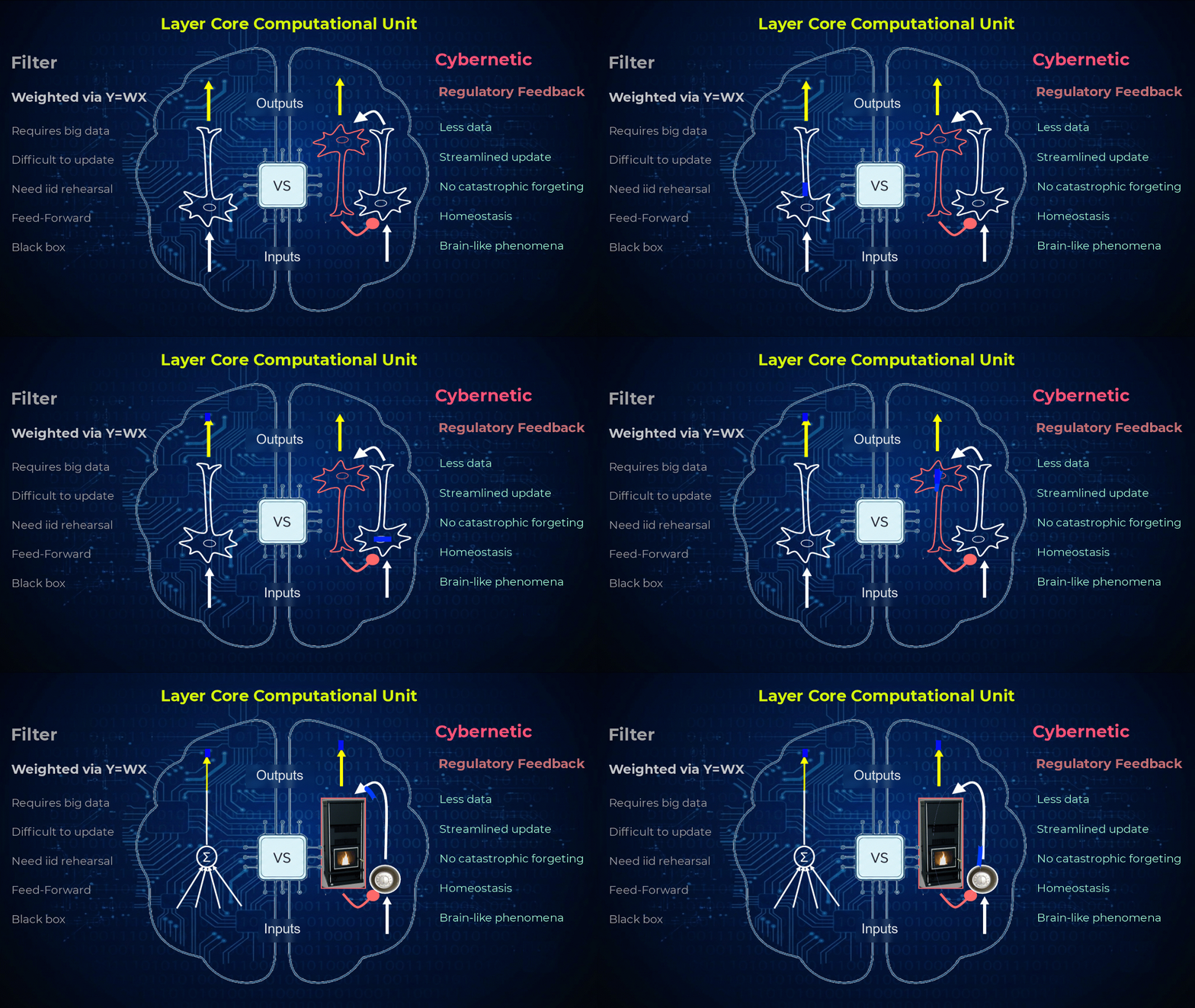
In this paradigm, the brain functions much like a thermostat and a furnace, particularly the neurons that are involved in inference-recognition of the world.
This type of dynamic, self-correcting feedback is found everywhere in biology, from cellular gene regulation to macroscopic behavior. It aligns perfectly with the core principles of stability and control I initially studied in electrical engineering—concepts that are fundamental to biological reality but largely absent from modern computer science.
The Rise of the “Snapshot” AI
After 1948, the computational modeling of the brain slowly shifted. The advent of filter-based computational units prioritized feedforward configurations.
While there have been massive advancements—recurrent networks (RNNs), LSTMs, transformers, and reinforcement learning—filter methods absolutely dominate AI today. The paradigm is so deeply entrenched that almost no one looks at alternatives. Yet, any AI developer or researcher intimately knows the problems this approach creates:
- Massive Data Dependency: Filter methods require gargantuan databases to function.
- i.i.d. Rehearsal: All data must be shuffled together and rehearsed endlessly to prevent the network from forgetting old information when learning something new.
- Rigid Architecture: They are not easily updatable, controllable, or explainable. They cannot be dynamically primed the way human cognition can.
While these networks achieve impressive performance, they are essentially static snapshots produced in massive server factories. If you want to add new knowledge, you often have to rebuild the snapshot.
Through my laboratory work in electrophysiology and my clinical training in neurology, I have seen firsthand that the biological brain simply does not operate this way. The human brain, armed with a vast knowledge base, updates instantly, sequentially, and modularly as it encounters the world. It does not require a data center to shuffle its lifetime of memories just to learn a new face.
Resurrecting Regulatory Feedback Networks
During the decades that filter models dominated tech, cybernetics slowly morphed into a more holistic, sometimes spiritual approach, encompassing cognitive theories and treatment strategies. Unfortunately, it lost its appeal as a rigorous, computational approach to artificial intelligence. There has been a severe dearth of funding for cybernetic methods since the 1950s.
At Optimizing Mind, we are proving that this abandonment was premature. The cybernetic approach is not just a biological curiosity; it is a mathematically rigorous computational framework.
- Biological Evidence: Negative feedback loops exist between brain neurons, with a massive body of literature supporting their ubiquity in sensory systems, the spine, thalamus and cortex.
- Mathematical Parity: It can be mathematically proven that feedback neural networks—specifically thermostatic regulatory feedback networks—can do everything filter neural networks can do2–4. They can be configured identically, and the fixed points (the stable solutions achieved once feedback has iterated) can be identical to the fixed, ideal solutions of filter networks.
The Core Difference: Normalizing Activations vs. Weights
If the mathematical destinations are the same, why switch paradigms? Because the journey changes everything about how the system learns and scales.
With filter neurons, the network weights must be normalized for all the data at once. During training, all the weights are aggressively adjusted to accommodate the entire dataset.
Cybernetic neural networks flip this entirely. They do not adjust globally over a massive dataset during a distinct “training” phase. Instead, during recognition, the feedback normalizes the specific parts of the network that get activated for that specific input.
This shift is highly unintuitive to today’s machine learning orthodoxy, but the benefits are exactly what we need to build truly adaptable systems:
- Independent Updatability: New neurons can be added or activated with virtually no destructive interference to the rest of the network.
- Natural Learning: Training does not require independent and identically distributed (i.i.d.) shuffling. The network can learn examples sequentially as they appear—just like a human does.
- Control and Explainability: Because of its inherent feedback loop, the system is deeply explainable and can be dynamically primed. It is especially suited for the cognitive layers closest to a system’s outputs.
Filter-based models have taken us far, but they are approaching a wall of diminishing returns and unsustainable computational costs. To move forward, we have to look back at the origins of neural computation. We have to stop building passive filters and start building dynamic, self-regulating systems.
Under the Hood: Filters vs. Furnaces
To truly appreciate this paradigm shift, we need to look at the wiring of these networks. At a structural macro-level, cybernetic regulatory feedback networks and standard filter-based networks share the same basic anatomy.
Both paradigms rely on sensory inputs (X) and recognized outputs (Y). Both can be constructed using the exact same modern architectures: they can be arranged into deep layers, spatial convolutions, recurrent loops for time-series, or even transformer topologies. If you were to map them out, the inputs (X) and outputs (Y) can represent the exact same things.
But that is where the similarities end. The fundamental difference lies in how the network moves from X to Y, and consequently, what the weights between them must represent.
The Filter Method: A Single Multiplication
In standard feedforward neural networks, finding the output Y is a rigid, one-way street. Information flows from the inputs, which are passively filtered by a matrix of weights (W). The process is defined by a simple, static equation:
Y = WX
The network finds Y through a single multiplication pass. Because the entire recognition process is forced into the single feedforward calculation, all of the complexity, environmental context, and uniqueness must be permanently baked into the weights themselves. This is why filter methods require massive data centers to painstakingly normalize those weights over millions of training cycles.
The Cybernetic Method: The Thermostat and the Furnace
In a regulatory feedback network, the computation is alive and dynamic. It operates on the cybernetic principle of the thermostat and the furnace.
In this paradigm, the sensory input X acts as the setpoint to the thermostat (the external reality the network is attempting to match). The output Y acts as the furnace state (the network’s internal representation or active hypothesis).
Crucially, the signal to the furnace is regulated simultaneously by both the input setpoint and the current furnace state. Instead of a single mathematical snapshot (Y = WX), the network finds Y through multiple, rapid iterations of this thermostat-furnace interaction. The active outputs continuously send regulatory feedback to their own inputs. This recursive loop continues until the neurons (the furnaces) mathematically settle on the optimal, stable values for Y.
Because the network actively and iteratively hunts for the correct activation state during the moment of recognition, the weights themselves are fundamentally different. They do not need to contain the rigid, globally normalized data of a billion past examples. The burden of resolving ambiguity is shifted away from a massive, offline training phase and placed exactly where it belongs: in the dynamic, real-time moment of recognition.
Natively Emulating Cognitive and Neuroscience Phenomena
Not only does this cybernetic paradigm dramatically ease the requirements for learning, but its iterative nature natively emulates well-known brain phenomena without the extensive set-ups and parameters researchers use today when trying to force filter networks as models of the brain.
Because the network actively iterates to resolve ambiguity during recognition, the continuous regulatory feedback naturally mirrors profound cognitive phenomena. For example, the system inherently displays difficulty with similarity—such as yielding slower responses and search asymmetries when confronted with highly similar, competing inputs. The network takes physically longer to mathematically settle, perfectly emulating human cognitive reaction times without requiring artificial delays.
Furthermore, this model natively replicates foundational neuroscience phenomena, such as the excitation-inhibition balance. This critical biological balance originates organically from the control system dynamics as it drives the predictive error to zero, entirely bypassing the need for the complex, artificially engineered lateral architectures required in modern deep learning.
We believe these types of cybernetic regulatory neural networks will inevitably return to become the future of both AI and foundational research, profoundly furthering our true understanding of the human brain.
Learn More and Contribute to Benchmarking
At Optimizing Mind, we are actively building and testing these regulatory feedback networks, and we want to share that progress with you. We invite you to visit the Optimizing Mind website to read our full whitepaper and explore the benefits of the model. I also encourage you to watch our detailed video overview.
Most importantly, you can experience the benefits yourself. We have set up the first live trial of our Flash Transfer Learning API, where you can run your own inputs and benchmark the faster learning using less data that avoids catastrophic forgetting. This is a hybrid application that trains in thermostat form but provides snapshot filters for easy integration into existing applications.
Our goal is to post a list of successful accelerations within all the different paradigms this technology benefits. We hope you can apply this to different applications and show benchmarks—we will proudly post your name and application!
Building a biologically plausible, truly adaptable model of the brain is a monumental task, and no single discipline holds all the answers. But by stepping back and rethinking our fundamental computational building blocks, we can get much closer to understanding cognition and advancing artificial intelligence.
Thank you for reading. I look forward to exploring these ideas further with you—subscribe to join the conversation, and let’s figure out how to build it better.
Sources utilized:
- Wiener, N. (1948, 1961 Ed). Cybernetics: Or Control and Communication in the Animal and the Machine, https://doi.org/10.7551/mitpress/11810.001.0001
- Achler, T. (2023). What AI, Neuroscience, and Cognitive Science Can Learn from Each Other: An Embedded Perspective. Cognitive Computation. https://doi.org/10.1007/s12559-023-10194-9
- Optimizing Mind Whitepaper. https://www.optimizingmind.com/whitepaper
- Achler, T. (2016). Neural phenomena focus.