When AI Sours: How Efficient Training Changes the ROI Math
Investors and enterprise leaders are actively scrutinizing artificial intelligence spending, questioning whether massive capital investments are translating into sustainable returns. Industry data highlights a widening divide: while vast sums flow into infrastructure, nearly 80% to 95% of enterprise AI projects still struggle to deliver measurable profit-and-loss returns. As the payoff proves hard to capture, enthusiasm is beginning to cool.
The initial ease of deploying generative tools attracted explosive growth, but the ongoing reality of maintaining nimble, flexible AI applications is souring those efforts. The core issue? AI training and maintenance are brutally difficult.
The hidden cost of AI is no longer building the initial model, it is the continuous burden of keeping it current. While foundational models have driven massive progress by reducing upfront training demands, maintaining an AI system that stays updated and task-specific remains an uphill battle. The root of this struggle is often blamed on the “big data” requirements of AI, but the reality is far more complex.
The Illusion of the Big Data Problem
The distillation of the “big data problem” is actually a much more nuanced flaw within the algorithm itself. It is a problem that is difficult for even seasoned data scientists to grasp because most modern developer tools completely hide its origins.
The origin of the issue is this: the AI algorithm in its popular form is fundamentally inflexible for learning.
TRADITIONAL FILTER-BASED NEURAL NETWORK
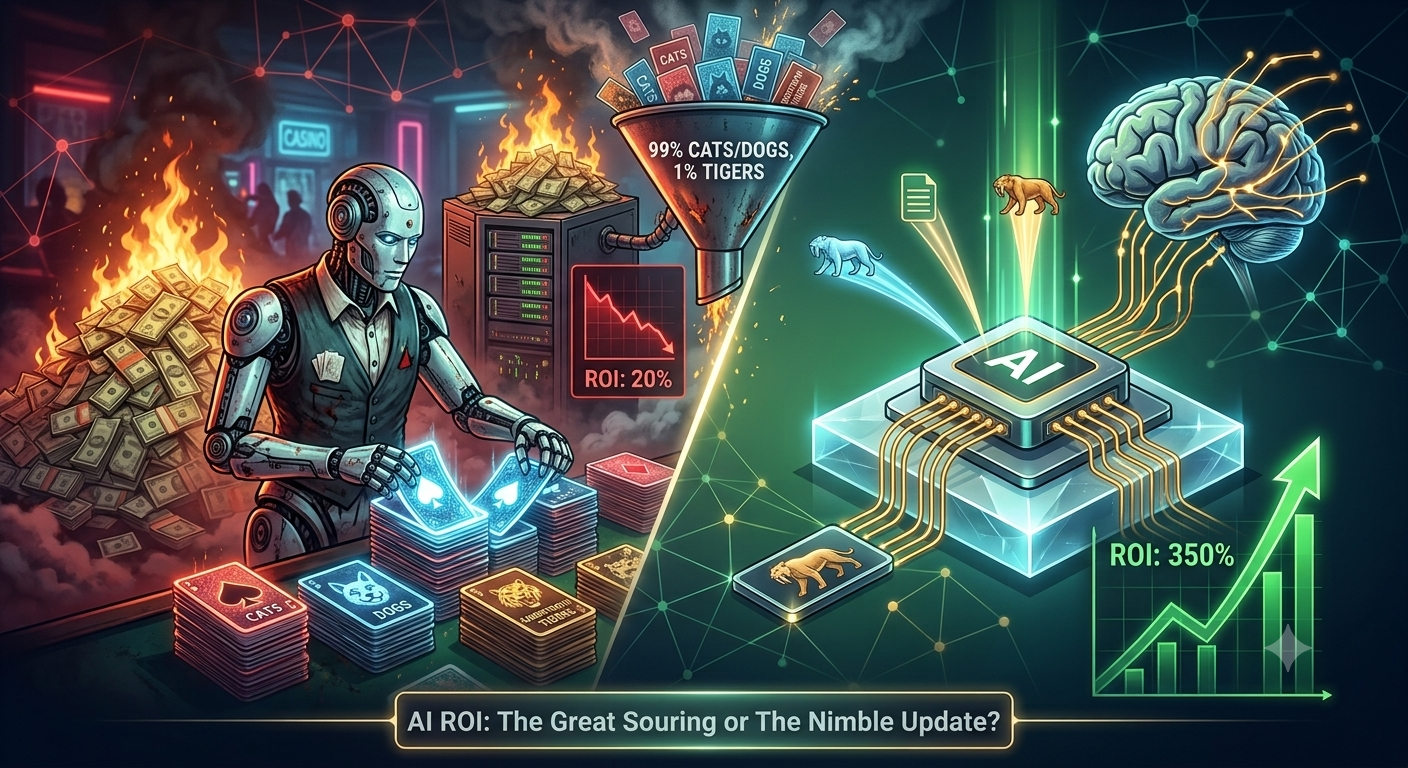
i. Must acquire equal samples (Cats = Dogs = Tigers)
ii. Shuffle all historic + new data (“Casino Dealer”)
iii. Full retrain of network weights (Exorbitant Compute)
1. The Data Balancing Trap
First and foremost, traditional neural networks require data to be perfectly balanced. Imagine you are training an AI to recognize cats, dogs, and sabretooth tigers. The algorithm demands the exact same number of examples for each category.
- If you have 1,000 pictures of cats and 1,000 pictures of dogs, but only 3 pictures of a sabretooth tiger, the algorithm will fail to work properly.
- To make the algorithm function, you must artificially generate or source 997 more sabretooth tiger examples.
Finding or generating those extra examples is not only incredibly expensive, but it is also highly error-prone.
2. The Casino Dealer Shuffle (Data Rehearsal)
Once you finally balance the data, you face the next algorithmic hurdle: you must shuffle all of the data randomly, much like a casino dealer.
Because of this, making even a minor update means you essentially need to restart training from the beginning. If your company wants to add another feature or another thing for the network to recognize, you must:
- Obtain balanced data for the new feature.
- Combine it with all the old data your company has gathered.
- Retrain everything from scratch using both old and new data.
This complete data rehearsal is cumbersome, slow, and expensive—even when you are only learning or fine-tuning the top layer of a massive foundational model.
Why the Flaw is Unintuitive: The Biological Contrast
Biological brains simply do not have this problem. If a human sees one sabretooth tiger, they don’t need to look at 997 more (nor do they need to aggressively shuffle their memories of cats and dogs) to permanently learn what a sabretooth tiger is.
Because human cognition natively bypasses these hurdles, the origins of AI’s “big data” updating problems remain profoundly unintuitive. This algorithmic inflexibility ultimately translates to the failure of otherwise promising AI projects in ways that are not intuitive to investors or even many data scientists.
Fixing the “Last Mile” of AI with Flash Transfer Learning
It doesn’t have to be this way. AI remains super promising, offering incredible new power and excellent foundational bases. The missing link is the “last mile”—creating updatable AI that is specific to a task, capable of learning on the spot without catastrophic forgetting.
Modifying the algorithm of neural networks to avoid casino-style rehearsal and update as it goes along is a monumental solution to a problem we can barely wrap our heads around, simply because our heads do not have this problem. Paving the way for learning without balanced data leads to truly updatable, nimble AI.
OPTIMIZING MIND: FLASH TRANSFER LEARNING™
i. Learns incrementally without data balancing
ii. Self-normalizing control loop (No “Casino Shuffle”)
iii. Instant updates on top of foundational backbones
Enter Optimizing Mind
Investors should not sour on AI; instead, they should look for methods and encourage their companies to seek out approaches that are natively updatable and require vastly less data because they don’t require balanced data.
Optimizing Mind offers a definitive solution: Flash Transfer Learning. Designed to learn on top of foundational models, Flash Transfer Learning changes the math of AI ROI.
Originating from the brain computation studies of our founder (an MD/PhD), Flash Transfer Learning utilizes an algorithm that intuitively self-normalizes.
- Zero Data Balancing Required: Learn on unbalanced real-world data without generating artificial samples.
- No Rehearsal or Shuffling: Update individual node representations incrementally without restarting training or wiping past memory.
- Radical Efficiency: Drastically reduce the compute demands, infrastructure costs, and engineering overhead associated with AI maintenance.
We give your team the encouragement to try Flash Transfer Learning and see the difference in their applications. We believe this technological shift will make or break a company’s AI nimbleness, driving the ultimate success of trainable, personalizable AI that trains on the spot.
Get Started Today
Stop burning capital on full retraining cycles. Explore Optimizing Mind to turn the promise of updatable, nimble AI into a commercial reality.